• Projects
  • Platforms
  • Use Cases
  • Blog
  • Signals
  • Services
  • About Us
  • Projects
  • Platforms
  • Use Cases
  • Blog
  • Signals
  • Services
  • About Us
  • ENG
  • SRB
MindPlaySport — AI-Powered School Sports Infrastructure
AI-Powered Sports Infrastructure

MindPlaySport

AI-powered infrastructure platform for school sports, safe communication, and mental performance development.

A SaaS platform combining team management, secure communication, mental training, and AI-assisted monitoring into one scalable system — built for schools and sports academies.

Request pilot Explore opportunity Partner with us
GDPR compliant
AWS hosted
Multi-tenant SaaS
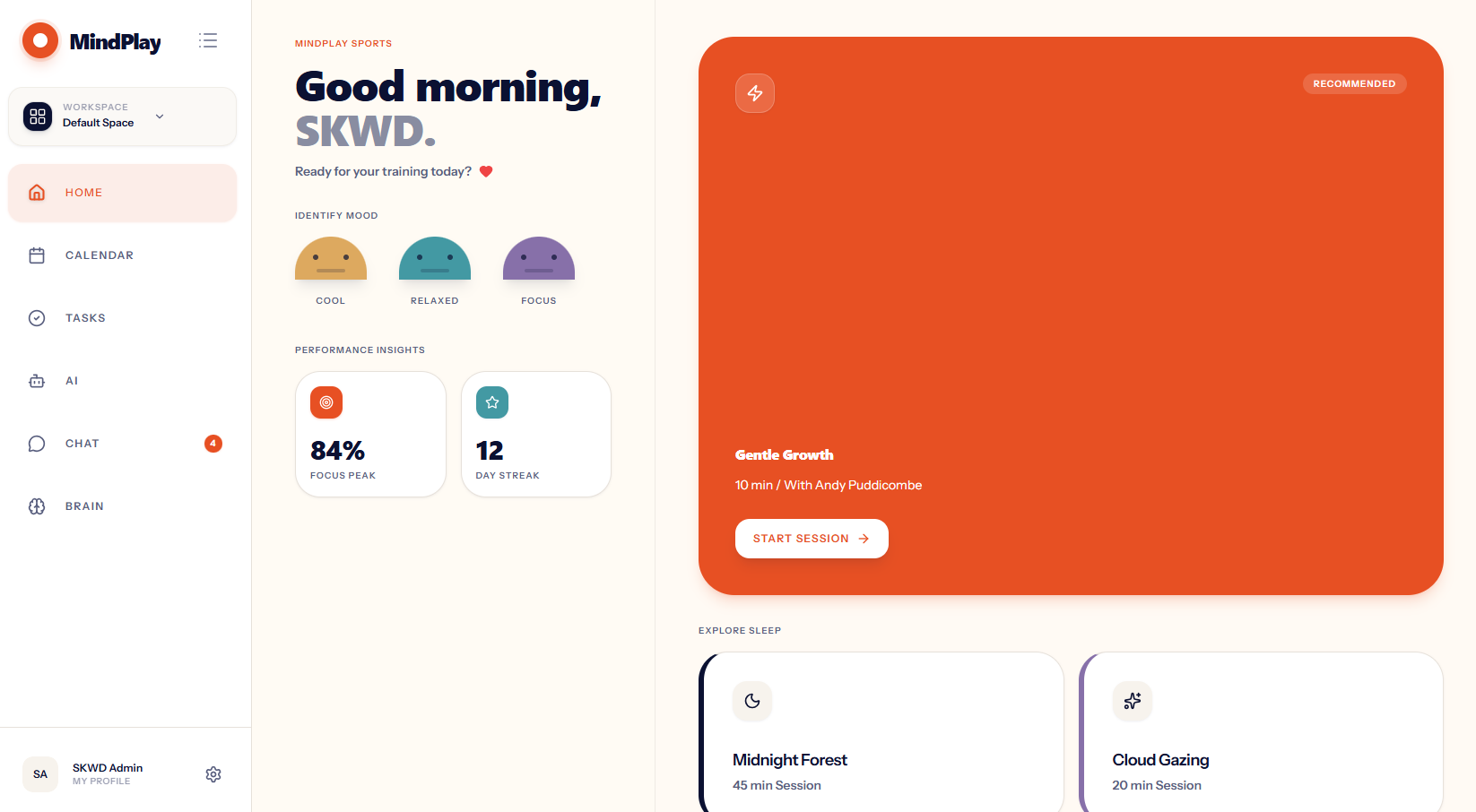
mindplaysport.app · Home
MindPlaySport dashboard screenshot
The problem

School sports still runs on fragmented,
disconnected tools

Organizations manage communication, scheduling, and training in silos — while facing growing concerns those tools completely ignore.

Mental health of young athletes

No structured support systems in existing sports tools

Unsafe digital communication

No monitoring or preventive safety infrastructure

Lack of centralized oversight

Schools have no single operational visibility layer

No structured support systems

Development tracking is absent from most platforms

19,500+

Schools in the USA market

8.2M+

Annual student-athlete participations

0

Dominant integrated platforms in the segment

mindplaysport.app · AI
MindPlaySport AI chats screenshot
The insight

The real problem is infrastructure, not tools

The absence of a safe digital infrastructure connecting schools, coaches, parents, athletes, and mental development systems into one operational environment.

Existing tools optimize activities

Scheduling apps, chat tools, training trackers — all operating separately

MindPlaySport optimizes the entire ecosystem

One infrastructure connecting every stakeholder and system in one environment

The solution

One centralized platform for every stakeholder

MindPlaySport provides a multi-tenant SaaS platform where each school operates within its own protected digital environment while remaining connected to a broader institutional sports structure.

Sports organization management
Secure communication
AI-assisted monitoring
Mental training
Educational content
Analytics & reporting
Features

Everything the ecosystem needs

Four core capabilities — each backed by a real module inside the platform.

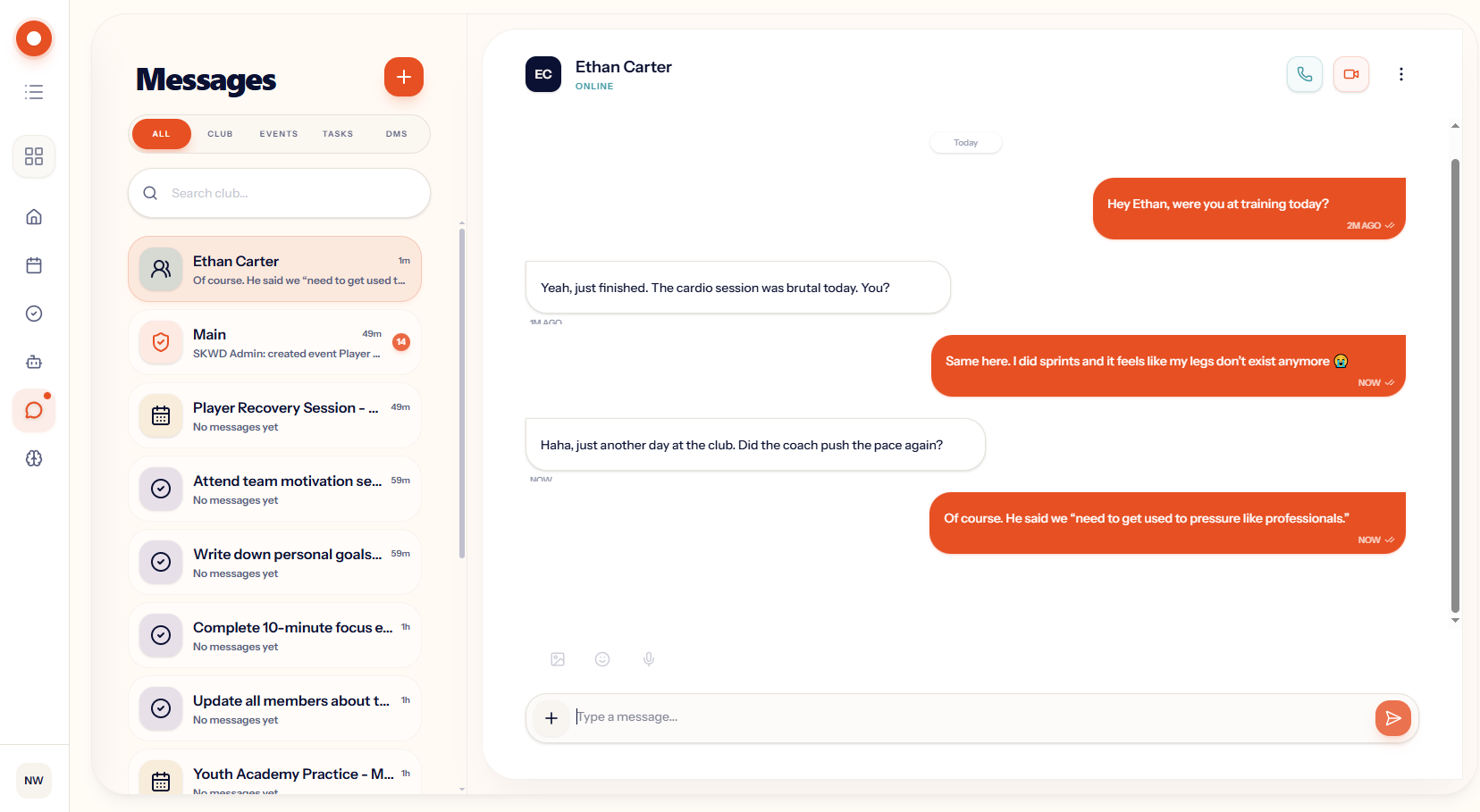
mindplaysport.app · Chat
MindPlaySport secure messaging screenshot

Safe AI communication monitoring

AI-assisted detection of conflicts, toxic communication, and behavioral risks in digital interactions — before they escalate.

Real-time tone analysis
Risk flagging for administrators
Preventive action support
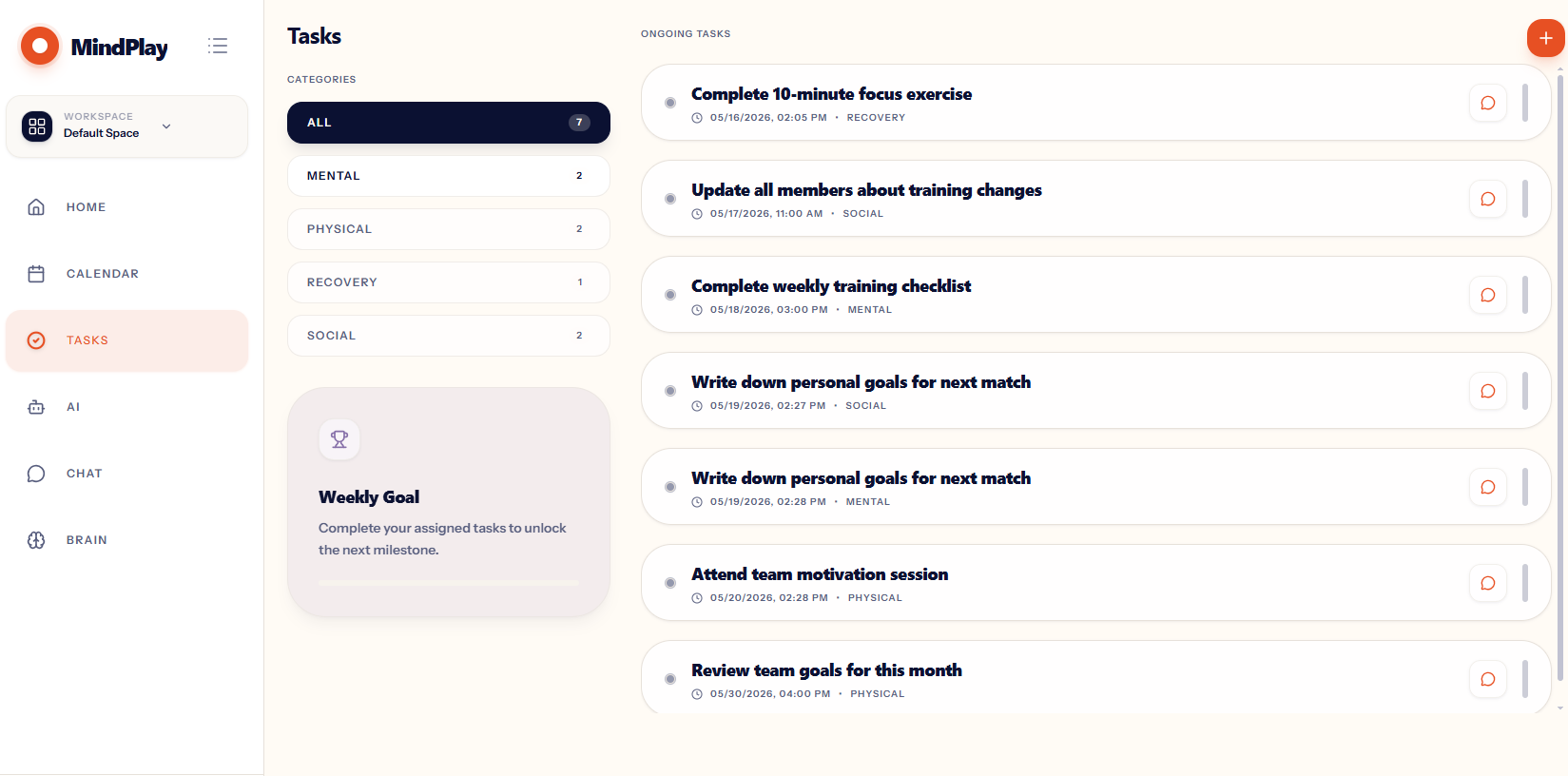
mindplaysport.app · Tasks
MindPlaySport tasks screenshot

Mental performance development

Integrated mental training modules, cognitive exercises, and educational content tailored for young athletes — organized by Mental, Physical, Recovery, and Social categories.

Weekly goals and milestones
Structured task categories
AI-guided coaching sessions
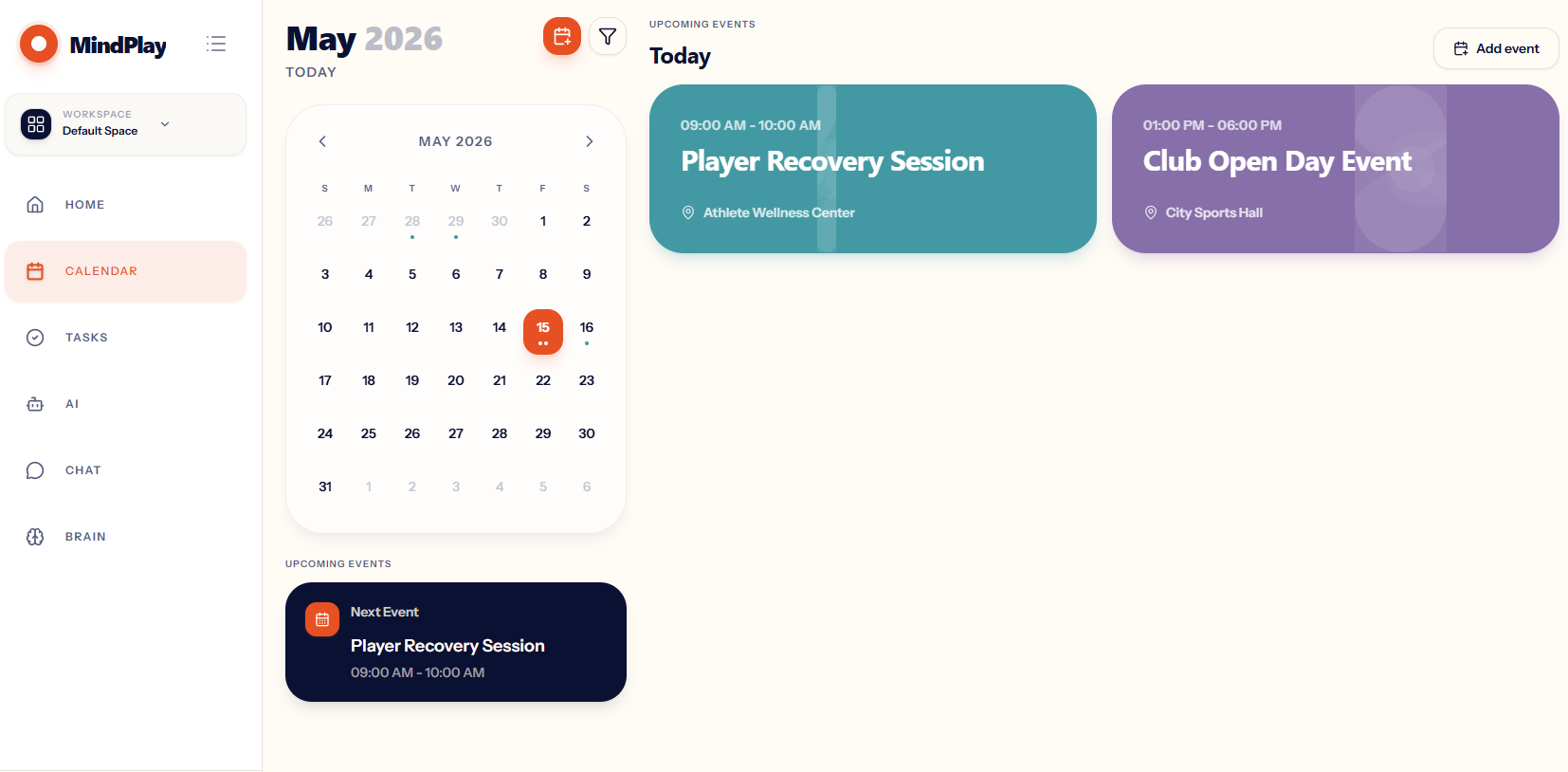
mindplaysport.app · Calendar
MindPlaySport calendar screenshot

School & team management

Management of schools, teams, coaches, athletes, schedules, and operational workflows — all within a unified calendar and event system.

Shared team calendars
Event and session scheduling
Role-based access for all participants
How it works

From onboarding to insights in 4 steps

1

Schools join the platform

Organizations onboard into their dedicated digital environments.

2

Coaches and athletes collaborate

Communication, tasks, schedules managed in one secure system.

3

AI supports safety and well-being

AI monitoring identifies risks and supports preventive actions.

4

Organizations track development

Schools gain visibility into operational and athlete progress data.

Value

Business benefits

Reduces operational fragmentation

One platform replaces multiple disconnected tools.

Improves athlete safety

AI-backed communication transparency.

Supports mental well-being

Long-term athlete development infrastructure.

Scalable national infrastructure

Built for schools, clubs, and federations.

Predictable recurring revenue

SaaS model with institutional subscription.

Compliance readiness

Strengthens institutional oversight.

Who it's for

Built for the entire sports ecosystem

School sports organizations
Sports academies
National school sports federations
Coaches and trainers
Parents and guardians
Young athletes
Market

Operating at the intersection of four growing markets

SportTech
EdTech
Mental Health
Safe AI Infrastructure

19,500+

Schools in the USA market

8.2M+

Annual student-athlete participations

No dominant platform

No integrated solution owns this segment

Current stage

MVP / Validation Phase

Architecture defined, development in progress, pilot validation planned with selected schools.

MVP development in progress
Architecture and business model defined
Pilot validation — planned
USA market entry — planned
Get involved

Ready to build the future
of school sports?

Whether you're a school, an investor, or a potential partner — we'd love to connect.

Enterprise

School and academy onboarding

Request pilot

Investor

Explore the opportunity

Explore opportunity

Partner

Technology and distribution

Partner with us

Signals

  • Jun.30
  • Product

The revised growth plan starts with 10–20 schools.

The revised growth plan begins with a 0–12 month validation phase, targeting 10–20 schools, or approximately 4,500–9,000 users. This phase should validate the pricing model, sales cycle length, onboarding process, and initial case study examples.

Data: 10–20 schools / 4,500–9,000 users
Status: Planned validation phase
Next:

Secure 3–5 reference implementations.

Project: MindPlaySportBlog: Why school sports need more than team management software
  • Jun.20
  • Compliance

FERPA and COPPA readiness is a launch requirement

Because MindPlaySport works with minors in the US market, the platform must plan for FERPA and COPPA readiness, including access control, data processing, consent and a clear privacy policy. AI communication monitoring also requires transparent usage rules.

Data: FERPA / COPPA readiness required
Status: Compliance planning needed before launch
Next:

Run a US legal review before broader commercialization.

Project: MindPlaySportBlog: Why school sports need more than team management software
  • Jun.13
  • Product

MVP focus: clubs, communication, AI monitoring

The MindPlaySport MVP focuses on core modules: club and user management, chat, tasks, calendar, AI communication monitoring, mental training and basic analytics. The goal of the MVP phase is not feature breadth, but validation that schools accept an integrated system for organization, communication and mental development.

Data: Core MVP modules defined
Status: MVP phase / market validation
Next:

Test whether schools accept one integrated system for sports organization, safe communication and athlete development.

Project: MindPlaySportBlog: Why school sports need more than team management software
  • Jun.06
  • Market

USA school sports market: 19,500+ high schools

MindPlay Sports primarno cilja USA tržište školskog sporta, koje obuhvata približno 19.500–19.800 srednjih škola i više od 8,2 miliona sportskih učešća u školskoj 2024–2025. godini. Ovo potvrđuje dovoljno veliki adresabilni segment, ali prioritet ostaje validacija kroz prve pilot škole.

Data: 19,500+ high schools / 8.2M+ sports participations
Status: Market validation
Next:

Validacija kroz 10–20 pilot škola u prvoj fazi.

Project: MindPlaySportBlog: Why school sports need more than team management software

Blogs

Why school sports need more than team management software

  • June 30, 2026

School sports are not only about practice schedules, player lists and communication between coaches and parents. They are environments where young athletes develop discipline, confidence, resilience and a relationship with the team. That is why digital tools for school sports need to go beyond basic organization.

Most sports apps start from a practical problem: how to organize a team more easily. That usually means calendars, messages, attendance, member lists and announcements. These tools are useful, and they solve real everyday problems.

But school sports carry a different level of responsibility.

They do not involve only coaches and athletes. Parents, schools, administrators, sports organizations and, most importantly, children and young people in development are part of the system. That means digitalizing school sports is not only about efficiency. It is also about safety, trust and long-term development.

MindPlaySport starts from the idea that school sports do not need just another organizer. They need a safer system.

Organization is only the first layer

Practice schedules, tasks, announcements and communication matter. Without them, any sports program quickly becomes inefficient. Coaches lose time on administration, parents lack clear information and athletes often do not know what is expected of them.

But when a digital product stops at organization, it solves only the surface layer of the problem.

The real question is: what happens inside that communication system?

Is the communication clear?
Is it safe?
Does it support the athlete or create additional pressure?
Can the school notice risky patterns?
Does the coach have a tool that helps them respond in time?

This is where the difference begins between a simple app and a platform for school sports.

Communication in school sports is a developmental space

For young athletes, messages are not just information. The way a coach gives feedback, how conflict is handled, how defeat or mistakes are communicated — all of this affects the athlete’s mental development.

That is why a communication system in school sports cannot be a neutral space without context. It has to be structured enough to support responsible behavior and safe enough to protect participants.

MindPlaySport introduces the logic of safe communication, where AI support can identify negative tone, potential conflict or risky patterns — not as a replacement for people, but as support. The system should help coaches, schools and responsible staff notice earlier what they might otherwise see too late.

Mental development should not be separated from sports work

Mental training is often treated as an add-on: something delivered occasionally through a separate program, app or workshop. But for young athletes, mental development happens every day.

It happens during practice.
It happens after a loss.
It happens in the relationship with the coach.
It happens in team communication.
It happens when an athlete learns how to process a mistake and continue.

That is why mental development should not be separated from the sports system. It should be part of the same digital environment where tasks, communication, progress and behavior are managed.

This is one of the key differences in the MindPlaySport approach: mental training is not extra content. It is part of the overall structure.

Schools are not only buying software. They are buying trust.

When a school introduces a digital tool used by minors, the decision is not the same as with a typical SaaS product. It is not enough for the product to work. It has to be safe, understandable, transparent and aligned with the responsibilities of the institution.

That is why trust is central to the product.

Parents want to know that communication is safe.
Coaches want a tool that does not make their work harder.
Schools want a system that reduces risk.
Organizations want a structure that can scale.

If a platform can connect all these needs, it stops being just a tool. It becomes part of the infrastructure of school sports.

Team management apps usually solve the needs of an individual team. MindPlaySport has a different ambition: to support schools, sports programs and organizations through a multi-tenant system that can grow.

That means each school can have its own digital environment, while the broader system keeps structure, standards and central management capability.

This matters because school sports are not just a collection of independent teams. They are an institutional ecosystem.

And institutional ecosystems cannot rely only on disconnected tools in the long run.

School sports do need better tools. But more than that, they need safer systems.

A system that organizes work.
A system that protects communication.
A system that supports mental development.
A system that helps coaches, schools, parents and athletes work inside the same space of trust.

That is where MindPlaySport builds its position: not as another team app, but as a platform for safer and smarter school sports.

Read More >

Why parents of children on the autism spectrum must not be left alone

  • May 26, 2026
  • Social Impact

When we talk about children on the autism spectrum, we most often talk about therapies, development, communication, education, and professional work. All of these are important topics.

But there is another part of the problem that often remains less visible: the everyday life of parents.

Parents of children on the autism spectrum do not carry only the organization of therapies. They carry the schedule, communication with professionals, financial pressure, emotional burden, concern about the child’s future, and often the feeling that the system around them is not connected enough.

That is why Mindplay Puzzle should not be just an application. It should be part of a broader support system.

The idea behind the project is simple: technology can help with communication and organization, but all profit generated by the platform should return to where it is needed most — into concrete support for parents and children.

At this moment, that primarily means support for day centers and extended care programs.

Parents live the system every day

For professionals, therapy has an appointment. For institutions, support has a program. For parents, autism is everyday life.

This means that a parent is not involved in only one part of the day. A parent follows routines, changes in behavior, reactions, sleep, nutrition, communication, school, therapies, waiting times, transportation, and unpredictable situations.

They often have to be the organizer, translator, coordinator, support person, and advocate for their child.

That is why we cannot talk about supporting the child without supporting the parent.

If the parent has no space to rest, if there is no safe service they can trust, if there is no system that understands their daily reality, then supporting the child also becomes more difficult.

The problem is not only financial

Families of children on the autism spectrum often face significant expenses: therapies, medical examinations, additional treatments, specialized materials, transportation, private support, and adapted activities.

But the problem is not only money.

The problem is also time. The problem is availability. The problem is the lack of places where the child can be safe. The problem is that parents often have to connect different parts of the system by themselves.

That is why support for parents must not be only declarative. It must be practical.

Parents need support that can be seen in real life: more available services, more safe spaces for children, more time for the family, and less of the feeling that they are alone.

Why Day Centers and Extended Care Programs matter

Day centers and extended care programs are not just places where a child spends time.

For many families, they mean structure, safety, and relief.

They provide the child with an environment where they can have routine, support, and activities adapted to their needs. They give the parent time to work, handle responsibilities, rest, or simply function without constant pressure.

This is not a luxury. It is a basic part of support.

If society wants to help children on the autism spectrum, it must also help parents endure everyday life. Day centers and extended care programs are one of the most concrete ways to do that.

The role of the Mindplay Puzzle Platform

Mindplay Puzzle has two connected roles.

The first is product-related: to help the child express needs, emotions, choices, and reactions more easily, and to help parents and professionals understand and track that communication better.

The second is social: to ensure that the profit generated by the platform does not remain only a business result, but is directed toward helping families.

This means that Mindplay Puzzle is not building only a digital tool, but a model in which the product and social support work together.

The application can help with everyday communication. The profit can help with everyday life.

That is the essence of the model.

Profit as a mechanism of support

In a traditional startup model, profit is the final goal.

In the Mindplay Puzzle project, profit should be a mechanism for expanding support.

The idea is that all profit should be directed toward forms of help that truly matter to parents. At this stage, the priority is day centers and extended care programs, because they directly respond to one of the greatest needs of families: safe and structured time for the child, while reducing the pressure on parents.

Later, this model can expand to other forms of support:

· subsidized therapies,

· parent education,

· professional workshops,

· support for local centers,

· a fund for families who cannot afford services,

· development of accessible educational materials.

But the first step must be concrete and easy to understand.

Profit returns to families through support they can actually feel.

Why society matters

Parents of children on the autism spectrum cannot and should not do everything alone.

If a family is left alone, the burden becomes too great. If the system is not connected enough, the parent has to compensate for what is missing. If there are not enough day centers, extended care programs, and accessible support services, everyday life becomes a struggle that lasts for years.

That is why the broader community must be involved in providing support: companies, institutions, foundations, professionals, donors, and citizens.

Mindplay Puzzle can be one way to organize that support better.

Not as a replacement for the public system. Not as a replacement for professionals. Not as a grand promise.

But as a practical model that connects a digital product, families, professionals, and concrete forms of support.

Mindplay Puzzle starts with the child, but it must not forget the parent.

The child needs a tool to be better understood. The parent needs a system so they are not left alone. Society needs a way to make support more concrete.

That is why the idea behind the Mindplay Puzzle platform is broader than an application.

It is an attempt to create a product that helps with everyday communication, but also a model that directs all profit into real support for families.

At this moment, the most important forms of that support are day centers and extended care programs.

Because parents do not need only a beautiful message.

They need help that can be seen in the day they have to carry.

Read More >

About Us

SKWD is a product-driven R&D team focused on building scalable digital platforms, combining technology, strategy, and real-world execution to create solutions that deliver long-term impact.

Contact Info

  • info@skunkworksden.com
  • Location

Socialize

Linkedin
© 2026 SKWD. All rights reserved.
  • ENG
  • SRB
  • Projects
  • Platforms
  • Use Cases
  • Blog
  • Signals
  • Services
  • About Us
  • ENG
  • SRB