
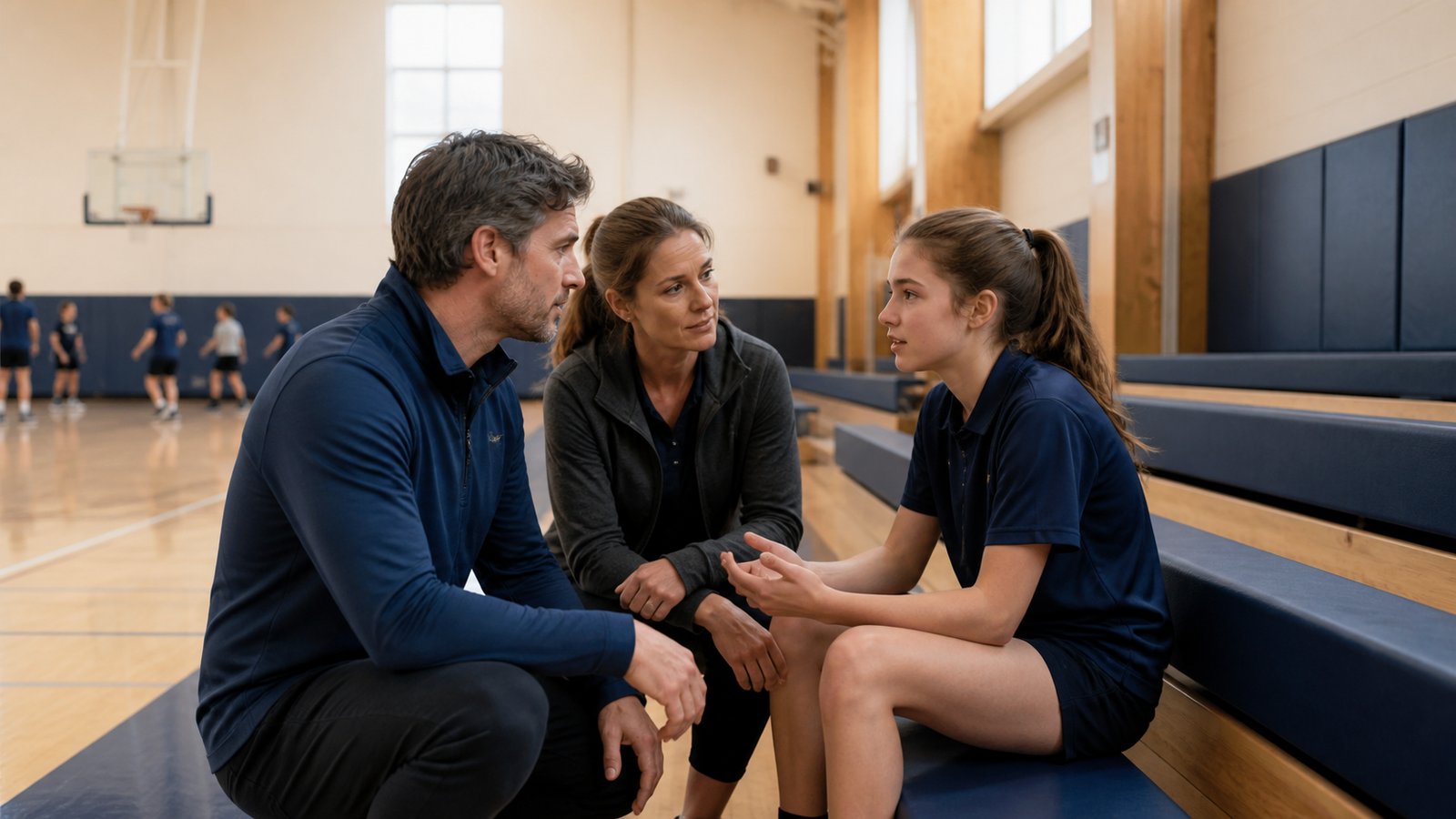
Most sports apps organise calendars, messages, attendance and announcements. Those functions solve real daily problems, but they cover only the administrative layer of school sport.
Schools also carry responsibility for safe communication, safeguarding and the development of children and young people.
They do not involve only coaches and athletes. Parents, schools, administrators, sports organizations and, most importantly, children and young people in development are part of the system. That means digitalizing school sports is not only about efficiency. It is also about safety, trust and long-term development.
MindPlay Sport starts from that wider responsibility: the product has to coordinate the team while giving institutions a clearer way to support safe communication and athlete development.
Organization is only the first layer
Practice schedules, tasks, announcements and communication matter. Without them, any sports program quickly becomes inefficient. Coaches lose time on administration, parents lack clear information and athletes often do not know what is expected of them.
But when a digital product stops at organization, it solves only the surface layer of the problem.
The next question is what happens inside that communication system:
- Is the communication clear?
- Is it safe?
- Does it support the athlete or create additional pressure?
- Can the school notice risky patterns?
- Does the coach have a tool that helps them respond in time?
Those questions distinguish a simple app from a platform for school sports.
Communication in school sports is a developmental space
For young athletes, messages are not just information. The way a coach gives feedback, handles conflict and communicates defeat or mistakes affects the athlete’s mental development.
That is why a communication system in school sports cannot be a neutral space without context. It has to be structured enough to support responsible behavior and safe enough to protect participants.
MindPlay Sport introduces the logic of safe communication, where AI support can identify negative tone, potential conflict or risky patterns. It supports people rather than replacing them. The system should help coaches, schools and responsible staff notice earlier what they might otherwise see too late.
Mental development should not be separated from sports work
Mental training is often treated as an add-on: something delivered occasionally through a separate program, app or workshop. But for young athletes, mental development happens every day.
- During practice
- After a loss
- In the relationship with the coach
- In team communication
- When an athlete learns how to process a mistake and continue
That is why mental development should not be separated from the sports system. It should be part of the same digital environment where tasks, communication, progress and behavior are managed.
This is one of the key differences in the MindPlay Sport approach: mental training is not extra content. It is part of the overall structure.
Schools are buying trust as well as software
When a school introduces a digital tool used by minors, the decision is not the same as with a typical SaaS product. It is not enough for the product to work. It has to be safe, understandable, transparent and aligned with the responsibilities of the institution.
That is why trust is central to the product.
- Parents want to know that communication is safe.
- Coaches want a tool that does not make their work harder.
- Schools want a system that reduces risk.
- Organizations want a structure that can scale.
If a platform can connect all these needs, it stops being just a tool. It becomes part of the infrastructure of school sports.
From app to infrastructure
Team management apps usually solve the needs of an individual team. MindPlay Sport has a different ambition: to support schools, sports programs and organizations through a multi-tenant system that can grow.
That means each school can have its own digital environment, while the broader system keeps structure, standards and central management capability.
This matters because school sports are not just a collection of independent teams. They are an institutional ecosystem.
And institutional ecosystems cannot rely only on disconnected tools in the long run.
Conclusion
School sports do need better tools. But more than that, they need safer systems.
- A system that organizes work
- A system that protects communication
- A system that supports mental development
- A system that helps coaches, schools, parents and athletes work inside the same space of trust
That is where MindPlay Sport builds its position: not as another team app, but as a platform for safer and smarter school sports.