

Mindplay Puzzle should not be seen only as an app for parents, special educators, therapists and institutions.
If the core problem is communication for children on the autism spectrum, then the child cannot be only the person adults exchange information about. The child has to be an active user of the system.
This is an important shift in product positioning.
Mindplay Puzzle should help the child express what they want, feel, reject, need or cannot explain verbally. Only then does the platform create full value for parents and specialists, because it provides better insight into the child as well as better records.
The problem is not only adult coordination
In the support system for children on the autism spectrum, there are often several adult actors: parents, special educators, therapists, schools, centers and institutions.
All of them matter. But if we look at the product only through their needs, we can easily end up with a platform that records information about the child, without helping the child communicate enough.
That is the difference between a tracking system and a support system.
A tracking system asks:
What did adults record about the child?
A support system asks:
What is the child trying to say?
Mindplay Puzzle should start from the second question.
The child as an active user
For many children on the autism spectrum, communication is not simple. Some children do not use speech. Some use limited vocabulary. Some know what they want but cannot express it easily. Some can communicate, but withdraw or react through behavior when stressed, overloaded or faced with a change in routine.
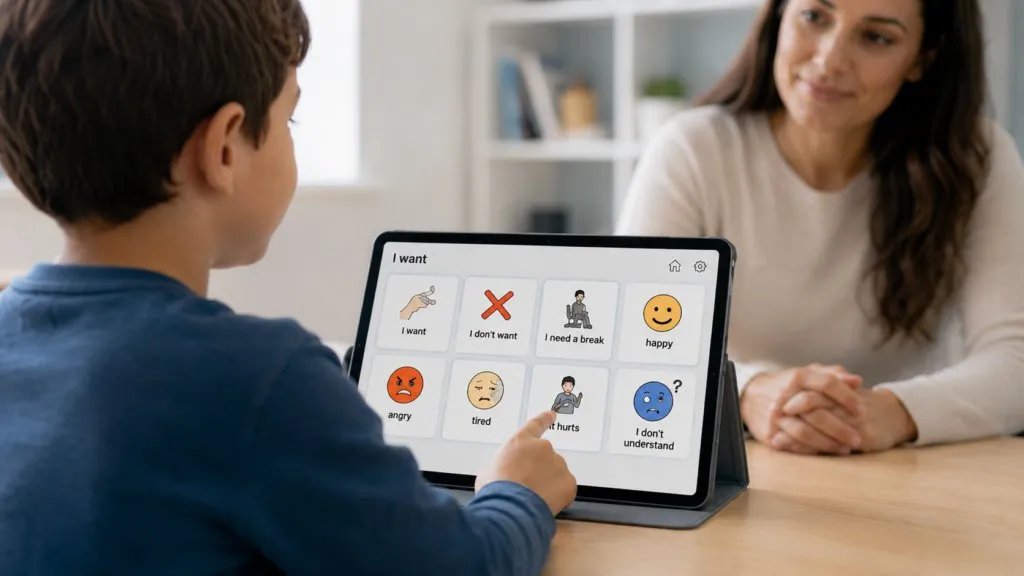
That is why a digital product has to offer a simple and visual way of expression.
The child can show:
- I want this
- I do not want this
- It hurts
- I am tired
- I am happy
- I am angry
- I need a break
- I want more
- I am finished
- I do not understand
These are not “small” features. They are basic communication bridges.
If the child can show a need or emotion more clearly, the parent and specialist can understand the situation faster. They rely less on assumptions and more on a signal that comes from the child.
Parents and specialists remain essential
This positioning does not reduce the role of parents and specialists. On the contrary, it makes their role more important.
- The parent still sees everyday reactions, routines and challenges.
- The special educator or therapist still leads professional work.
- The institution still provides the support framework.
But now they are not only working around the child. They are working with signals the child can express more directly.
That is the key difference.
Mindplay Puzzle should not replace professional work. It should not pretend to be therapy. It should not promise diagnosis or a medical solution.
Its value is to make communication clearer, everyday support more structured and progress more visible.
Why the roundtable matters
The internal roundtable between special educators and developers was important because it brought together two perspectives.
Special educators understand developmental needs, behavior, communication barriers and real situations in working with children.
Developers understand how these problems can be translated into simple flows, screens, data, rules and user experience.
When these two types of knowledge work together, the product does not become a generic app. It becomes a tool designed around a real problem: helping the child be better understood.
That is why the roundtable conclusion matters: Mindplay Puzzle must have a child-facing layer, not only an adult-facing panel.
How this changes the MVP
The earlier MVP could be defined through three flows: daily activities, parent–therapist communication and progress tracking.
Now the MVP should include four flows:
- Child visual communication A simple interface based on images, symbols, emotions, needs and choices.
- Daily activities Structure for routines, tasks and everyday activities.
- Parent–specialist communication Exchange of information, comments and recommendations between adults supporting the child.
- Progress tracking Records of reactions, activities, frequency and changes over time.
This change matters because the child-facing part becomes a source of signals. Parents and specialists no longer track only what they enter, but also what the child chooses, repeats, rejects or shows.
From app to communication bridge
If Mindplay Puzzle remains only an organization tool, its value is useful but limited.
If it becomes a communication bridge between the child and the people supporting them, its value becomes much stronger.
Then the platform does not only answer “how can the parent and therapist collaborate better,” but also “how can the child participate in that collaboration more easily.”
Mindplay Puzzle should be more than an activity log, a progress diary or a chat between adults.
Mindplay Puzzle should be a space where the child can say more easily: I want this, this bothers me, this is how I feel, this is what I need.
Conclusion
The most important shift in Mindplay Puzzle’s positioning is simple: the child must be at the center of the product as an active user.
Parents, special educators, therapists and institutions remain a key part of the system, but the platform should not be built only for them. Its strongest value appears when it helps the child communicate with them more easily.
That is why Mindplay Puzzle should start with the child’s voice, rather than with technology, administration or adult dashboards. It starts with the basic question:
How can the child be better understood?